Creative Commons Licence: All You Need to Know
4 November, 2025
Introduction
Sharing creative work is easier than ever before. From photos and videos to music and educational content, millions of works are created and shared daily across the internet.However, copyright law governs how these works can be used, copied or modified. This is where the Creative Commons (CC) licence system plays a crucial role.
Creative Commons licences provide a flexible, legal framework that allows creators to share their works with the public while retaining certain rights. Whether you are a student, educator, artist, or business owner, understanding Creative Commons licences can help you use and share content legally and responsibly.
What is a Creative Commons Licence?
Creative Commons licenses give everyone from individual creators to large institutions a standardized way to grant the public permission to use their creative work under copyright law. A Creative Commons licence is a type of public copyright licence that enables creators to grant permission to others to use their work, under certain conditions. Instead of the traditional "all rights reserved" copyright, which restricts use unless expressly permitted, CC licences offer a spectrum of rights to copy, distribute, modify, or build upon a work legally. The key idea behind Creative Commons is to promote sharing and collaboration while protecting the interests of creators. These licences help clear up confusion about what others can do with a work, reducing the risk of copyright infringement.
Why Were Creative Commons Licences Created?
Traditional copyright law provides creators with exclusive rights to their work, but this can sometimes limit the free flow of ideas and creativity. Before Creative Commons, creators had only two broad choices:
-
Keep all rights reserved, restricting all uses unless explicitly authorised, or
-
Put the work in the public domain, relinquishing all rights entirely.
Creative Commons was developed to create a middle ground-giving creators flexibility to choose how much control they want to keep while encouraging lawful sharing. The licences were introduced in 2002 by Lawrence Lessig, Eric Eldred, and others, inspired partly by the need to address long copyright terms upheld in cases like Eldred v. Ashcroft (2003), which extended copyright duration significantly.
Versions and International Scope of Creative Commons Licences
Since its first release in 2002, Creative Commons licences have evolved over several versions. The latest, Version 4.0, was published in 2013.
Why Versions Matter
-
Each version improves clarity, international applicability, and legal robustness.
-
Earlier versions were often "ported" or adapted to local laws and languages in various countries, including India, to make licences enforceable locally.
-
Version 4.0, however, is designed to be jurisdiction-neutral, reducing the need for porting. This means the same licence text applies globally.
Creative Commons in India
India adopted and uses CC licences widely, especially in educational and cultural sectors. Indian government projects like the National Repository of Open Educational Resources (NROER) have used CC BY-SA licences to release educational content freely to the public.
Understanding the Core Elements of Creative Commons Licences
Creative Commons licences are composed of four key elements. These are combined in various ways to create different licences, each allowing certain uses and imposing certain conditions:
| Element | Abbreviation | Meaning |
|---|---|---|
| Attribution | BY | Credit must be given to the creator of the work. |
| ShareAlike | SA | Derivative works must be licensed under identical terms. |
| NonCommercial | NC | The work may not be used for commercial purposes. |
| NoDerivatives | ND | The work may not be modified or adapted in any way. |
Each licence always includes Attribution (BY), which means the original author must be credited when their work is used.
The Six Most Common Creative Commons Licences
By combining these elements, six popular licences have emerged. Here is what each licence allows and restricts:
1. CC BY (Attribution):
This license enables reusers to distribute, remix, adapt, and build upon the material in any medium or format, so long as attribution is given to the creator. The license allows for commercial use. Allows others to copy, distribute, display, perform, and adapt your work-even commercially-so long as they credit you.
2. CC BY-SA (Attribution-ShareAlike):
This license enables reusers to distribute, remix, adapt, and build upon the material in any medium or format, so long as attribution is given to the creator. The license allows for commercial use. If you remix, adapt, or build upon the material, you must license the modified material under identical terms. CC BY-SA includes the following elements:
BY: credit must be given to the creator.
SA: Adaptations must be shared under the same terms.
Same as CC BY, but derivative works must be licensed under identical terms, encouraging sharing alike.
3. CC BY-NC (Attribution-NonCommercial):
This license enables reusers to distribute, remix, adapt, and build upon the material in any medium or format for noncommercial purposes only, and only so long as attribution is given to the creator. CC BY-NC includes the following elements:
BY: credit must be given to the creator.
SA: Only noncommercial uses of the work are permitted.
Others can adapt and use the work for non-commercial purposes only, with attribution.
4. CC BY-NC-SA (Attribution-NonCommercial-ShareAlike):
This license enables reusers to distribute, remix, adapt, and build upon the material in any medium or format for noncommercial purposes only, and only so long as attribution is given to the creator. If you remix, adapt, or build upon the material, you must license the modified material under identical terms. CC BY-NC-SA includes the following elements:
BY: credit must be given to the creator.
NC: Only noncommercial uses of the work are permitted.
SA: Adaptations must be shared under the same terms.
Non-commercial use only; derivatives must carry the same licence.
5. CC BY-ND (Attribution-NoDerivatives):
This license enables reusers to copy and distribute the material in any medium or format in unadapted form only, and only so long as attribution is given to the creator. The license allows for commercial use. CC BY-ND includes the following elements:
BY: credit must be given to the creator.
ND: No derivatives or adaptations of the work are permitted.
Allows redistribution, commercial and non-commercial, but no changes or adaptations allowed; attribution required.
6. CC BY-NC-ND (Attribution-NonCommercial NoDerivatives):
This license enables reusers to copy and distribute the material in any medium or format in unadapted form only, for noncommercial purposes only, and only so long as attribution is given to the creator. CC BY-NC-ND includes the following elements:
BY: credit must be given to the creator.
NC: Only noncommercial uses of the work are permitted.
ND: No derivatives or adaptations of the work are permitted.
Most restrictive: only allows others to download and share the work with attribution, but no changes or commercial use.
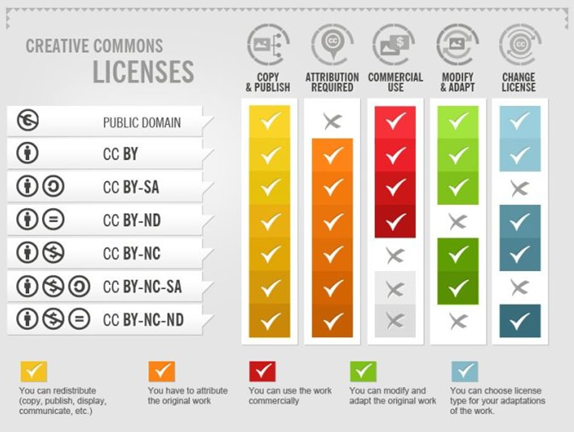
The figure below shows a good overview of what each license permits you to do:
What is CC0 or Public Domain Dedication?
Creative Commons also provides a CC0 (Creative Commons Zero) licence, which allows creators to waive all their copyright and related rights, effectively placing the work in the public domain.
- Anyone can use the work for any purpose without attribution or restriction.
- Widely used for data, scientific research, and government publications.
Applying Creative Commons Licences to Your Work
If you want to share your work using a Creative Commons licence, here are steps to follow:
- Decide which licence suits your goals – Do you want to allow commercial use? Are you okay with modifications?
- Mark your work clearly – Include the CC licence icon and a link to the licence deed (e.g., https://creativecommons.org/licenses/by/4.0/)
- Provide attribution guidelines – Use the "TASL" model: Title, Author, Source (link), Licence
- Publish licence information in metadata – This helps digital platforms identify your licence automatically
- Mark your work clearly – Include the CC licence icon and a link to the licence deed (e.g., https://creativecommons.org/licenses/by/4.0/)
Using Creative Commons Licensed Works
When using CC-licensed works, it is essential to:
- Check the licence type and version carefully – Some licences disallow commercial use or derivatives.
- Give proper attribution – Follow the TASL formula mentioned above.
- Respect licence restrictions – Do not use NC-licensed work commercially without permission, and avoid modifying ND-licensed works.
- Combine works with caution – Some licences (e.g., ShareAlike) require derivative works to carry the same licence. Mixing incompatible licences can lead to legal complications.
Creative Commons Licences in India: Current Scenario
India’s Copyright Act, 1957 protects authors’ rights but also recognises voluntary licensing arrangements like Creative Commons. CC licences have gained momentum in India, especially in:
Education: Open Educational Resources (OER) initiatives by government bodies and universities.
Cultural heritage: Museums and archives releasing content under CC to widen access.
Creative arts: Photographers, musicians, and writers sharing works online legally.
However, awareness remains limited among many creators and users in India. Government-funded resources often remain locked behind traditional copyright, limiting public benefit. Promoting CC licences is important to support India’s knowledge economy and digital inclusion goals.
Best Practices for Creators and Users
| For Creators | For Users |
|---|---|
| Choose licence aligned with your sharing goals | Always read the full licence text before use |
| Clearly mark your work with licence info | Provide accurate attribution using TASL model |
| Educate your audience about licence terms | Respect NonCommercial (NC) and NoDerivatives (ND) clauses |
| Keep licence metadata with your work | Ensure compatibility when mixing multiple CC works |
| Encourage remixing and sharing | Seek additional permissions if unsure |
Conclusion
Creative Commons licences have revolutionised content sharing by providing clear, flexible legal tools that respect creators’ rights while encouraging reuse and collaboration. For creators, CC licences offer a way to openly share work without losing control. For users, they provide legal certainty to build upon and enjoy creative works. In India, CC licences are a powerful enabler of open education, cultural exchange, and innovation.