Trademark Registration Process in India: Step-by-Step Process, Documents, Fees & Timeline (2026)
20 Aug, 2026
Introduction
What is the Trademark Registration Process in India? The Trademark Registration Process in India helps businesses protect their brand name, logo, symbol or other distinctive marks from unauthorized use. A trademark is one of the most valuable intellectual property assets of a business and enables it to build a unique identity in the market.
In India, trademark registration is governed primarily by the Trade Marks Act, 1999. A trademark in India is registered by filing Form TM-A with the Controller General of Patents, Designs and Trademarks (Trade Marks Registry). Applicants can file independently or authorize a registered trademark attorney or agent to handle the process. The government filing fee starts at Rs. 4,500 per class for individuals, startups, and small enterprises filing online. Registration takes 12 to 18 months and gives exclusive rights for 10 years.
You can contact Law Certis for hassel free Trademark registration process.
What Is a Trademark?
A trademark is a mark capable of distinguishing the goods or services of one person or business from those of others. It may include a brand name, word, logo, symbol, or slogan under the Trade Marks Act, 1999.
Governed by the Controller General of Patents, Designs and Trademarks, it protects your business identity, prevents unauthorized copying, and provides the right to use the ® symbol.
Why Should Indian Businesses Register Their Trademark?
Trademark Registration helps Indian businesses legally protect their brand name, logo and identity from unauthorized use. It gives the owner exclusive rights over the trademark, prevents competitors from copying the brand, builds customer trust, and adds value to the business. It also provides stronger legal protection against trademark infringement or disputes.
Who Can Apply for Trademark Registration?
Under India’s trademark framework, a person or entity claiming to be the proprietor of a trademark can apply for registration. This includes individuals, startups, SMEs, companies, partnership firms, trusts, societies and foreign applicants. Applications can be filed directly or through a registered trademark agent or attorney.
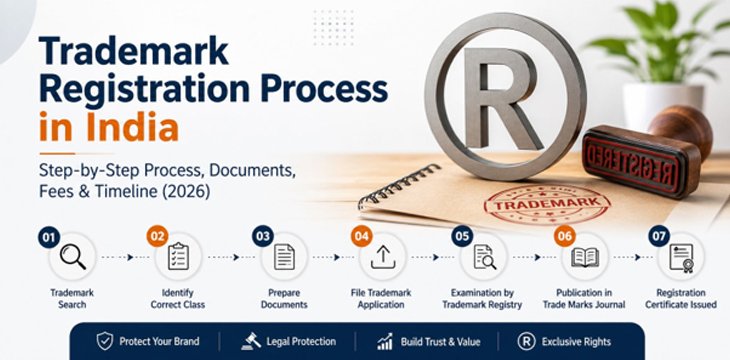
Overview of the Trademark Registration Process in India- Step-by-Step Guide
Step 1: Conduct a Trademark search
Search to ensure your proposed trademark is unique and not similar to existing trademarks.
Step 2: Identify the Correct Trademark Class
Select the appropriate trademark class based on goods or services. India follows the 45-class Nice Classification system.
Step 3: Prepare Your documents
Keep the required documents ready, such as applicant details, business details, trademark representation, and a Power of Attorney where applicable.
Step 4: File the Trademark Application
Submit the trademark application with the Trade Marks Registry along with the applicable government fee.
Step 5: Examination by the Trademark Registry
The Registry examines the application to check compliance and possible conflicts with existing trademarks.
Step 6: Publication in the Trade Marks Journal
If accepted, the trademark is published in the Trade Marks Journal, allowing third parties an opportunity to oppose it.
Step 7: Registration Certificate Issued
Once the process is complete, the trademark is registered, and the owner receives a Registration Certificate.
Documents Required
Prior to initiating the Trademark Registration Process in India, it is important to collect all the required documents. Having all the necessary documents required for trademark registration at hand makes the process easier and helps avoid unnecessary delays.
Identity Proof of the applicant
Address Proof of the applicant
Power of Attorney on Stamp Paper
Udyam Aadhar in case of a company
Incorporation documents in case of a company
User Affidavit on Stamp Paper
Trademark Registration Fees
| Package | Service required | Price per application for individual Applicants OR Companies having Udyog Aadhar Registration. | Price per application for Companies without Udyog Aadhar Registration. |
|---|---|---|---|
| Gold Trademark | Trademark Registration | Rs. 6,400/- | Rs. 10,900/- |
| Platinum Trademark | Trademark Registration | Rs. 9,100/- | Rs. 13,600/- |
| Platinum Plus Trademark | Trademark Registration | Rs. 12,700/- | Rs. 17,200/- |
Trademark Registration Timeline
Trademark registration in India generally takes 12–18 months, depending on the application and whether objections or opposition arise. The Trademark Registration Process in India typically includes application filing, examination, objection/response (if any), publication in the Trademark Journal, opposition period, and final registration. If there are no objections or oppositions, the process may be completed sooner.
What Can You Do with Just the Application Number?
With just a trademark application number, you can generally:
Check the application status on the IP India Trademark Registry portal.
View basic details such as the applicant’s name, trademark, class, filing date, and status.
Track whether the application is filed, under examination, objected, advertised, opposed or registered.
Check for examination reports, objections and other updates associated with the application.
Monitor the progress of the trademark until registration.
Benefits of Trademark Registration
Security of goodwill associated with your brand name
Secure Right to use your Brand Name across India
Registration Validity of 10 Years, which can be renewed
Grants right to stop misuse of your Brand Name
Intellectual property as an asset has appreciating value
Avoid accidental infringement on others' trademarks
Common Mistakes to Avoid
Choosing a generic or similar trademark without conducting a proper search.
Filing under the wrong trademark class.
Providing incorrect or incomplete applicant details.
Using an incorrect trademark description for goods or services.
Failing to respond to examination objections within the prescribed time.
Not monitoring the application status after filing.
Ignoring opposition notices published in the Trademark Journal.
Assuming that filing an application means the trademark is already registered.
Why Choose Law Certis ?
Since 2013, Law Certis has been providing professional Intellectual Property Rights (IPR) services in India, including assistance with the Trademark Registration Process. Based in Pune, Maharashtra, we serve clients across India and internationally, offering reliable support for trademark registration, intellectual property protection, and related legal services.
We have successfully established our goodwill in the market even after facing competition from heavily funded organizations due to our discipline and policies which we have evolved through experience in this industry.
Please be rest assured that you are giving the work to one of the best service providers in the market.
2000+ Trademark registrations
All India instant online service
Free expert guidance and analysis
All trademark services at one-stop
Trademark filing in 24 hours
Transparent pricing and service
Frequently Asked Questions
Trademark registration is the formal legal process of securing exclusive ownership rights for a unique brand identifier such as a name, logo, symbol, or slogan that distinguishes your goods or services from others in the marketplace.
The trademark registration process in India involves conducting a trademark search, selecting the appropriate class, filing the application, examination by the Trademark Registry, responding to objections if any, publication in the Trademark Journal, and finally obtaining the registration certificate if there is no successful opposition.
In India, the base government cost for trademark registration via e-filing is ₹4,500 per class for individuals, startups, and MSMEs, and ₹9,000 per class for large companies and LLPs.
Trademark registration typically takes between 12 to 18 months in a smooth, straightforward scenario without any objections or oppositions. However, if complications arise, the process can easily stretch from 18 to 24 months or longer. You can legally start using the ™ symbol within 1 to 2 days as soon as you file your application.
Yes, you can use the ™ symbol before your trademark is registered. It shows that you claim ownership of a brand name, logo, or slogan. You can use it before filing an application, while your application is pending, or even without an application.
Any person or legal entity claiming to be the proprietor of a trademark can apply for trademark registration. This includes individuals, sole proprietors, partnership firms, limited liability partnerships (LLPs), Indian and foreign companies, trusts, societies, and non-profit organizations, as detailed on the IP India portal.
The required documents depend entirely on what you are trying to do, such as applying for an Aadhaar Card, getting a Passport, opening a bank account, or verifying your identity.
Yes, you can register a logo and a brand name separately. In fact, doing so requires filing two distinct trademark applications: one as a word mark (protecting the brand name in plain text) and another as a device or figurative mark (protecting the visual logo design).
Yes, you can apply online for trademark registration in India through the official Intellectual Property India e-filing gateway. The digital process allows individuals, startups, and companies to submit applications, pay official fees, and track filings securely online.
Conclusion
Trademark Registration in India is an important step towards protecting a brand and securing exclusive rights over its use. The process generally involves trademark search, class selection, application filing, examination, publication, objection (if any) and registration. The overall process may take approximately 12 months to 1.5 years or more, depending on objections, hearings, or opposition proceedings. Once registered, the trademark is valid for 10 years and can be renewed indefinitely.
Thus, timely registration provides long term legal protection and strengthens the value and credibility of a business.